





CMMS
Why Running Multiple Brands on One FM Platform is Eating Your CapEx

Because when your fm platform can’t handle brand complexity, your capital budget pays for it.
When we talk to multi-brand operators who are looking for a new facilities management (FM) platform, we hear the same thing over and over: the existing system just isn’t keeping up.
These operators rarely cite some huge, catastrophic failure as evidence of their failing systems. Rather, they point to a steady accumulation of workarounds, manual reconciliations, and budget line items that exist because the platform requires them, not because you need them. If that sounds familiar, the problem doesn’t lie with your team. The problem lies with the platform’s outdated, inflexible architecture.
What Makes Managing Multiple Brands in FM So Complex?
Running multiple brands within one enterprise means that you can have very different operating models coexisting under shared financial accountability. After all, a managing partner at one restaurant chain doesn’t run their facilities the same as the manager of a totally different dining concept.
Each brand under a corporate umbrella carries its own vendor relationships, service priorities, approval thresholds, maintenance procedures, and P&L responsibility.
Different brands, different workflows
There is a common instinct among organizations to try to standardize everything. Consistency is a valuable thing, after all! The problem is that flattening your brands’ differences into a uniform workflow doesn’t actually simplify operations. Instead, it generates exceptions and workarounds, which eventually lead to increased costs.
When this happens, operators end up spending their time managing an unwieldy platform, rather than managing the business.
This creates a genuine tension that most platforms cannot resolve: operators need centralized visibility and control, but they also need to preserve brand-level autonomy. Those two priorities pull in opposite directions.
Different teams don’t often work from the same data
Although you want configurability, you don’t necessarily want completely divergent systems.
Across multi-brand restaurant groups, specialty retail, and similar enterprises, the facilities team that manages day-to-day maintenance and the team that makes capital decisions are frequently operating from different systems entirely.
This means that asset data captured at the operational level doesn’t flow downstream to the people making replacement and investment decisions. In turn, capital planning ends up relying on manually reconstructed information. Work gets repeated every planning cycle.
This is an architecture problem.
Related Reading
How a Flexible CMMS Is a Competitive Advantage
Why legacy platforms can’t keep up with multi-brand complexity — and what configurability actually buys you.
Read more →11 Signs It’s Time to Switch Your CMMS
Hidden fees, poor integrations, and zero scalability — the warning signs that your platform is costing you more than it saves.
Read more →The Cost of Neglecting Proactive Budget Management in Facilities
How advance planning and historical spend data become your best tools for defending the capital budget.
Read more →Why Is That Complexity Eating Your CapEx?
Customization has a price tag
Legacy FM platforms were not designed for multi-brand complexity. When you need brand-specific workflows, like distinct approval thresholds, separate budget structures, different vendor assignments by concept, the answer from legacy providers is typically, “Submit a paid change order.” If you do that across enough brands over enough years, the total cost of ownership climbs steadily, not because the operation grew, but because the platform charged to accommodate it.
This dynamic helps explain why multi-brand operators have historically concluded that no system can actually handle how uniquely they operate. It’s exactly why many have avoided committing to an enterprise platform at all. The cost of making it work always seemed to outweigh the benefit.
Platform independence matters more than you think
There is a structural issue worth examining when evaluating any FM platform: some are owned by companies that also sell services or manage capital delivery. A platform whose parent company benefits financially from your vendor spend has an organizational reason not to help you reduce it. That misalignment doesn’t always show up loudly. It tends to appear quietly, over time, in the CapEx budget. (And that’s a place where you don’t want to see any unnecessary costs!)
When comparing enterprise FM platforms, feature parity matters less than most managers assume. The truth is that most mature platforms are close to one another on core functionality. What differentiates them is configurability and whose interests the platform is designed to serve.
What Should Multi-Brand FM Actually Look Like?
Here’s what operators want: Each brand under a corporate entity should be able to run its own FM operating model within a single platform instance. Everything from workflows and vendor management to approval processes and P&L dashboards is configured to each brand’s preferences. There are no universal, inflexible templates in a successful FM ecosystem.
These are some of Fexa’s goals for multi-brand operators:
- Provide attainable governance without rigidity
- Centralize reporting and improve visibility at the enterprise level
- Preserve brand-level autonomy where it matters most, operationally
At Fexa, we believe that asset data should arrive clean and useful by default. It shouldn’t have to be reassembled retroactively. If you choose a platform that can be used throughout multiple brands and departments, then your capital planning and finance teams can use the system every day. This means they don’t have to go through a separate reconciliation project at the start of every planning cycle. They are already functioning within the platform.
Lastly, the platform’s economics should be aligned with the operator’s goals, not with a parent company’s service revenue or vendor network.
Fexa Demo Library
See Fexa in Action
Short product demos — under 2 minutes each — covering CMMS, work order management, FexaAI, and more.
How Does Fexa Solve This?
Fexa was built specifically for operators running multiple brands, sites, concepts, and operating models at enterprise scale. Our clients include restaurant groups, specialty retail, and beyond.
At Fexa, each brand gets its own configured workflows, approval processes, vendor relationships, and reporting within one platform instance — no flattening required. This also means there are no paid change orders for brand-level variations!
Capri Holdings, the luxury group behind Michael Kors and Jimmy Choo, is among the multi-brand operators that have relied on Fexa’s flexibility across distinct brand environments.
Read more about our clients and their reviews of Fexa’s CMMS.
Asset intelligence is built into the operational layer of Fexa’s platform. Cost history and repair-versus-replace signals are captured as work happens, which means the data downstream teams need for capital decisions is current and complete when they need it.
Fexa is an independent, purpose-built technology company. Its incentives are aligned with reducing operator waste, not increasing work order volume or preserving vendor spend on behalf of a services parent.
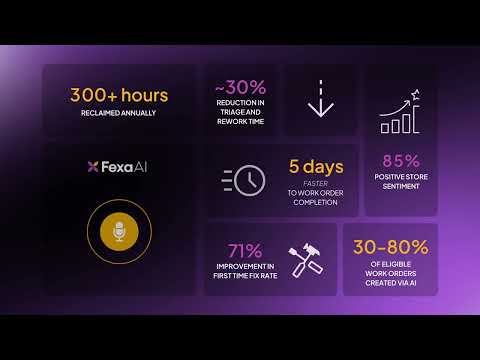
Our customers have seen what that alignment produces in practice: a medtail retailer grew locations by 43% with no increase in facilities headcount, and a national women’s loungewear retailer achieved more than $4 million in annual R&M savings. That’s an 11.4% reduction in maintenance spend per store.

The result is centralized operations with brand-level configurability. Specifically, we provide enterprise governance that doesn’t require every concept to run the same way.Ready to see how Fexa handles multi-brand complexity? Request a demo.
Related articles
Stay ahead of the curve with our insightful articles, expert opinions, and innovative trends.